

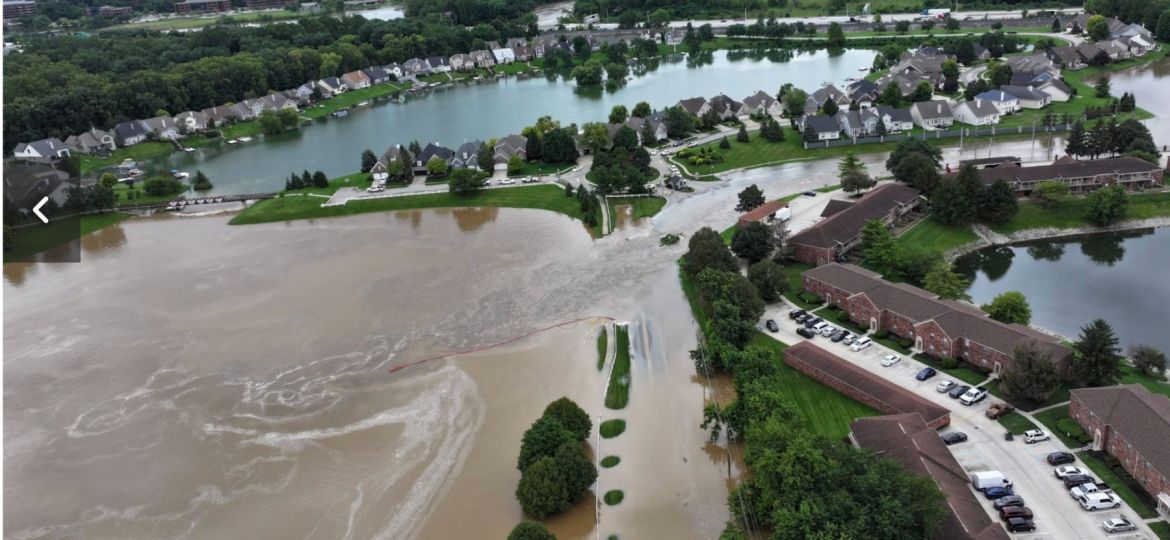
If your group chats or feeds have looked anything like ours this week, they’ve been a steady stream of storm photos, road closures, and “is your basement okay?” check-ins. After days of relentless rain, some parts of the region saw more than 11 inches in 72 hours. The White River crested in Indianapolis at a level not seen in more than a century, and flooding has touched neighborhoods from Broad Ripple and Ravenswood to Carmel, Noblesville, Fishers, and communities well beyond Marion County. Multiple deaths have been confirmed statewide, hundreds of people have been evacuated, and a presidential emergency declaration is now in place alongside disaster declarations in more than a dozen Indiana counties.
Whether you’re dealing with water in your own home or just trying to figure out how to show up for your neighbors, we pulled together what we know right now: who to call, where to go, and how to help without duplicating effort or sending things nobody actually needs. We’ll keep updating this as the picture becomes clearer.
If You Need Help Right Now
Life-threatening Emergency
Call 911. Do not drive through flooded roads — it takes surprisingly little moving water to sweep away a car.
Find a shelter
The Indiana Department of Homeland Security maintains a live shelter map. In Indianapolis, the Red Cross has been operating a shelter at the Washington Township Schools Services Center, 8401 Westfield Blvd. You can also reach the Red Cross directly at 1-800-RED-CROSS (800-733-2767); ask about pet-friendly options if you have animals with you.
Get Real-time Indianapolis Alerts
Text INDYFLOOD26 to 67283 for city updates on your phone.
Report Property Damage
This matters even if you don’t think you’ll ask for money — damage reports help the city and state document the scale of the disaster, which is part of what unlocks federal aid for the whole region. Report through Indiana 211’s online damage reporting tool, by phone at 211 or 866-211-9966, or through Indianapolis’s flood resources hub, which also has updates on road closures and recovery timelines for hard-hit areas like Ravenswood.
Apply for Federal Disaster Assistance
With the emergency declaration approved, individuals in affected counties may be eligible for FEMA help — including, in some cases, temporary hotel stays through the Transitional Sheltering Assistance program. Apply at disasterassistance.gov or call the FEMA helpline at 800-621-3362.
Indiana State Disaster Relief Fund
If insurance and federal aid still leave a gap, the state’s disaster relief fund can help residents in declared counties. Details and the application are available through the Indiana DHS disaster survivor resources page, which also links to housing, food (including D-SNAP), and medical assistance programs.
Mental Health Support
A flood doesn’t just damage a house, it’s traumatic. The 988 Suicide & Crisis Lifeline (call or text 988) is available 24/7, and Indiana’s DHS resource page also connects survivors to REST Team support.
Check Road Conditions
Before you go anywhere, check 511in.org for closures and flooding on your route.
County and City-specific Help
- Marion County / Indianapolis: indy.gov/activity/flood-resources for damage reporting, debris pickup, and recovery updates.
- Hamilton County: Fishers residents can call the 24/7 assistance line at (317) 595-3211 or fill out the form at FishersIN.gov/Flooding.
- Madison County: The Anderson Public Library has compiled a flood recovery resource list for the Anderson/Madison County area.
If your county isn’t listed here yet, start with 211, they can route you to local emergency management for your specific area.
Ways to Help
The instinct to load up a car with water bottles and old towels is a good one, but right now, the organizations coordinating on the ground say money is almost always more useful than physical donations, it lets them buy exactly what’s needed and get it to the right place fast. That said, several groups are also taking specific supplies. Here’s where things stand:
Give Money
- The Indianapolis Foundation — Flood Relief Fund for Marion County
- Hamilton County Community Foundation — Hamilton County Flood Relief Fund
- Heart of Indiana United Way — Long-Term Flood Recovery Fund, covering Delaware, Fayette, Henry, Madison, and Randolph counties, with 100% of gifts going to recovery. Donate here.
- Henry County Community Foundation — Flood Recovery Aid fund; call 765-529-2235 or email info@henrycountycf.org.
- Legacy Foundation — Lake County Disaster Relief Fund.
- Wayne County Foundation — Wayne County Cares Fund, Disaster Relief, with the option to designate a specific community.
- American Red Cross — Supporting sheltering, feeding, casework, and financial and mental health assistance statewide.
The Central Indiana Community Foundation has compiled the full, growing list of county-by-county relief funds if you want to give closer to home.
Give Supplies (Only What’s Requested)
- Firefly Children & Family Alliance is collecting diapers, wipes, formula, phone chargers, sleeping bags, pillows, bottled water, and cleaning supplies for displaced families.
- SERVE Village in Hamilton County is accepting donations and volunteers, currently prioritizing batteries, lanterns, water filters, work gloves, cleaning gloves, rakes, and paper goods. Drop-offs have been directed to the Hamilton County Fairgrounds, but call their support line first — (317) 645-3261 — since locations are shifting as needs change.
- Several local fire departments, including Buck Creek, Sugar Creek, Greenfield, and Vernon Township, along with The Local Radish, are also accepting donations and looking for volunteers to help sort supplies.
Volunteer
Sorting and distribution volunteers are being coordinated locally rather than through one central sign-up, so your best bet is calling SERVE Village, your township fire department, or checking with the Red Cross about active shelter needs before showing up. Cleanup crews should hold off entering flood-damaged homes until officials have cleared the area — floodwater carries real health risks, and untrained volunteers can add to the strain on emergency responders.
If you’re not sure where your help is needed most: 211 is fielding both requests for help and offers to help, and can point volunteers toward whichever effort actually needs hands that day.
This guide will be updated as recovery continues. If you know of a resource, fund, or need that should be added, let us know.
Support Local Journalism
Get the good stuff. Stay in the loop. to our weekly newsletter and join 5,500+ savvy locals getting event recs, insider tips, and exclusive content—like our must-have guide to Indy’s summer hidden gems. Sign up here.